June 18, 2026
Three labelling deadlines, one architecture decision. Inside the connected-product layer biotech leaders are quietly adding to every commercial launch.

A biotech asset spends a decade getting approved. Then it leaves the line, and almost nothing about it is connected anymore. No live link to the patient. No proof to a customs officer that it is genuine. No way to know, three months in, where it actually went. That gap is starting to show up in term sheets.
At BIO International this June, the conversations on the floor will be dominated by deals, partnering, and the commercial economics of newly approved assets. Underneath those conversations is a question that has quietly grown teeth: when the asset is yours, partnered, or licensed, what does its post-approval life actually look like in the real world?
For a growing cohort of biotech leaders, the answer is a new strategic surface called the connected-product layer.
One identifier on the pack. Everything else resolved server-side.
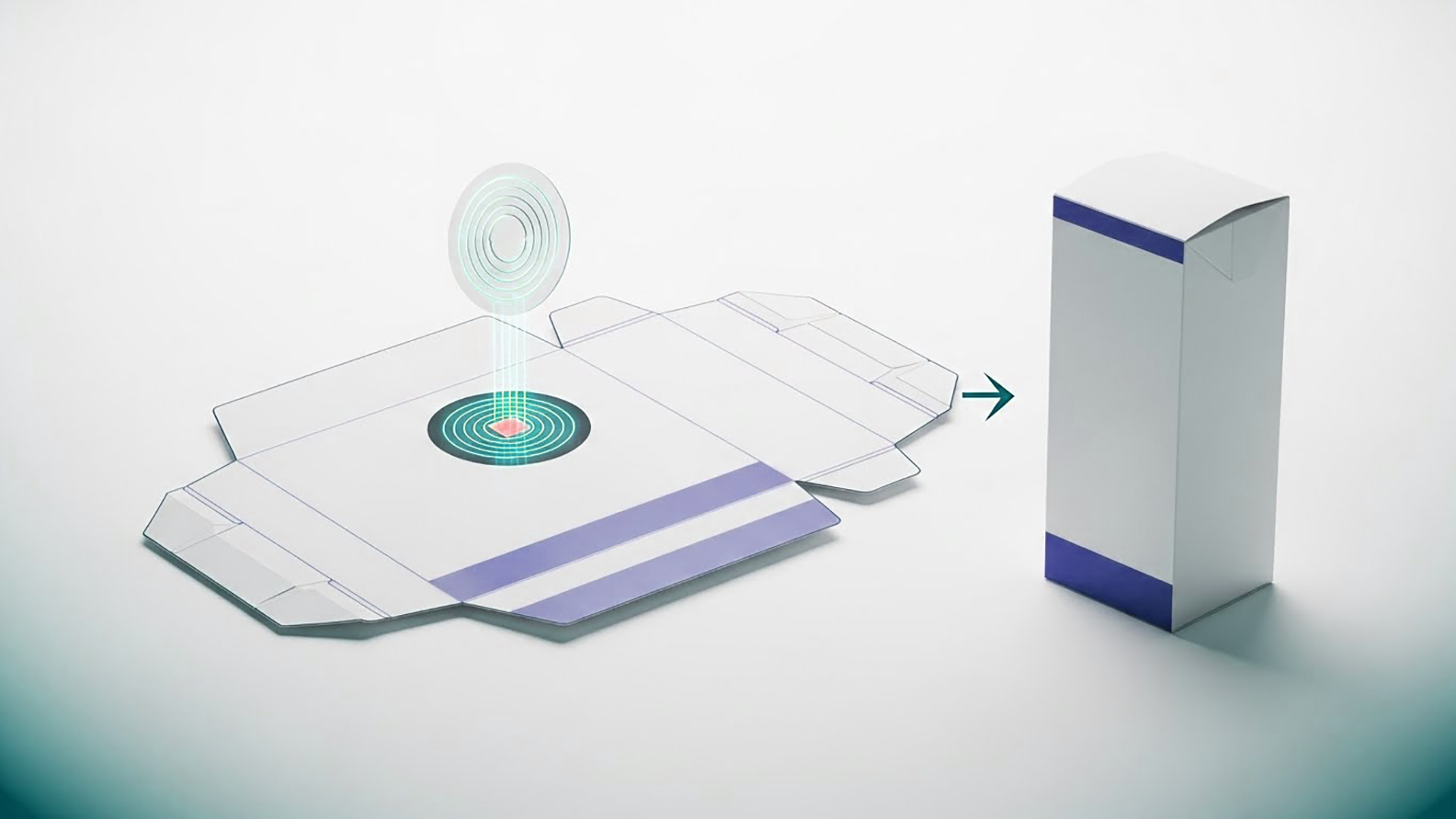
In practice, a connected-product layer means each unit of product carries a digital identity, encoded on a small chip embedded in the label or seal during normal lamination. From that one identity, four things resolve at the moment someone interacts with the pack:
None of this requires a new packaging line. Existing labels can be converted, the same applicators are used, and the chip adds less than 0.3 mm of thickness. It is an upgrade in place, not a rip and replace.
👉 Related reading: Printed Smart Labels: The Pharmaceutical Compliance Guide for 2026. How smart labels integrate into existing pharmaceutical labelling architecture without disrupting validated packaging lines, and where they intersect with serialisation and aggregation systems.
What makes this strategic, not tactical, is the calendar. Three labelling shifts are landing on the same production lines, on the same artwork files, in the same compliance cycle.
1. The EMA's electronic Product Information (ePI) roadmap. The European Medicines Agency published its draft implementation roadmap in March 2026. Vaccines under ATC code J07 go live on a voluntary basis in Q3 2026. Oncology products under ATC codes L01 and L04 follow in Q4 2026. All remaining Centrally Authorised Products progress on a phased voluntary basis from Q4 2026. Once the revised EU pharmaceutical legislation enters into application, ePI becomes mandatory for all newly authorised medicines. Initial implementation is English-only, with all other languages optional, and once a product's information is electronic, it remains electronic for every subsequent variation.
👉 Related reading: The ePI Roadmap Is Here: What Pharma Manufacturers Must Do Before Q4 2026. A full breakdown of the EMA timeline, the technical FHIR structure, and the operational moves manufacturers need to make now to land safely on the Q3 and Q4 2026 dates.
2. The US Drug Supply Chain Security Act (DSCSA). Enforcement is no longer a future event. The wholesale distributor stabilisation period ended on August 27, 2025. Large dispensers became enforceable on November 27, 2025. The final small-pharmacy compliance window closes on November 27, 2026. By BIO 2026, every US-marketed prescription drug is moving through an electronic, package-level traceability layer that is being actively policed.
3. The FDA's NDC12 final rule. On March 5, 2026, the FDA published a final rule standardising the National Drug Code to a uniform 12-digit format, structured as a 6-digit labeller code, 4-digit product code, and 2-digit package code. The effective date is March 7, 2033. A seven-year preparation window runs through 2033, followed by a three-year labelling transition through March 6, 2036. After that, drugs labelled with the legacy 10-digit format may be subject to regulatory action.
Three labelling shifts, three regulators, one production line. For a biotech preparing a US commercial launch or an EU partnered launch, all three land inside the typical six to twelve month packaging validation window.
Here is where it gets interesting for the audience walking the BIO floor.
When identity lives in print, every regulatory change is a packaging change. New format, new artwork file, new validation run, new label-stock burn-down, new system mapping. Multiply across a portfolio of 100, 500, or 1,000 SKUs, and the cost compounds for a decade.
When identity lives in a chip and resolves server-side, the printed face of the pack still updates on the regulator's schedule. But the identity layer underneath does not have to. A new field, like NDC12, becomes a configuration change, deployable across a portfolio in days. A new market with its own ePI specification becomes a content variation, not a packaging run. A future EU UDI extension, a tightened DSCSA requirement, a market-specific labeller code, all of it sits on the same architectural foundation.
This is the argument biotech CBOs are starting to bring to the deal room: the question is not whether your asset complies today, but whether its identity is built to absorb a decade of regulatory change without re-validating the line every eighteen months.
For cell and gene therapies, the connected-product layer is not a strategic enhancement. It is a definitional requirement. An autologous product is, by construction, item-level. There is no batch in any meaningful sense. The patient receives a unit that was manufactured for them, and the chain of custody between collection, processing, cryopreservation, and infusion is the product.
A connected identity on each vial, with verifiable provenance and live status, is not an add-on. It is part of the value the asset delivers. Biotech leaders bringing CGT platforms to commercial scale are increasingly treating this surface as a competitive feature, not a logistics task.
Biotech is rarely a single-market story. A US-approved asset is a Japan launch decision, a Korea licensing conversation, an EU registration plan, and a Latin America distribution question, often within the same quarter. The BIO floor reflects this: the registrations and the partners are global.
A connected-product layer carries the identifiers each market demands, without printing each one on the pack. NDC12 for the US. EU FMD safety features. GS1 GTIN as the global baseline. Market-specific ePI in the patient's language, resolved at the moment of tap or scan. One physical artefact, many regulatory faces. That is what makes a globally approved asset actually launch globally.
The hardest commercial lesson of the last 24 months has been the speed at which a high-value biotech asset can be counterfeited or diverted the moment it becomes commercially visible. The GLP-1 story is the clearest live case study: a multibillion-dollar class of biologic assets surrounded, almost overnight, by a counterfeit market that scales as fast as the legitimate supply chain.
👉 Related reading: GLP-1 Patent Expiry and the India Counterfeit Semaglutide Crisis. The clearest live picture of what happens to a multibillion-dollar biotech asset the moment it goes commercial, and what an item-level digital identity layer changes about the brand's response time.
When a connected-product layer is live, an off-market scan in a region the product was never shipped to becomes a real-time signal, not a post-quarter discovery. The OECD and EUIPO estimate the global trade in counterfeit goods at $467 billion annually. For a biotech asset, the cost is rarely just margin. It is patient harm, regulator scrutiny, and the slow erosion of the prescribing trust the asset took a decade to earn.
Four questions a CBO or licensing partner can now ask about an asset's post-approval layer:
None of these were standard diligence five years ago. By BIO 2027, they will be.
If you are mapping the ePI side of this for an EU-bound launch, see how the connected-product layer fits at forgestop.com/bio-epi. If brand protection and diversion are the immediate pressure, forgestop.com/bio-protect is the entry point and meet our CEO, Terry Katz, at BIO 2026 in San Diego, June 22 to 25.
Talk to ForgeStop about your asset's post-approval layer →
January 14, 2026
Printed smart labels embed NFC into existing pharma packaging — no new equipment needed. Learn how to deploy compliant, scalable smart labeling in 2026.

June 4, 2026
EMA's March 2026 ePI roadmap sets a Q4 go-live for vaccines and oncology. Here's the compliance checklist pharma manufacturers need to act on now.
March 22, 2026
Semaglutide's patent just expired in India, unleashing 50+ generics into a market where 28% of medicines are fake. Here's why authentication matters now.

.svg)
.svg)

.svg)
.svg)

