March 21, 2026
Semaglutide's patent just expired in India, unleashing 50+ generics into a market where 28% of medicines are fake. Here's why authentication matters now.
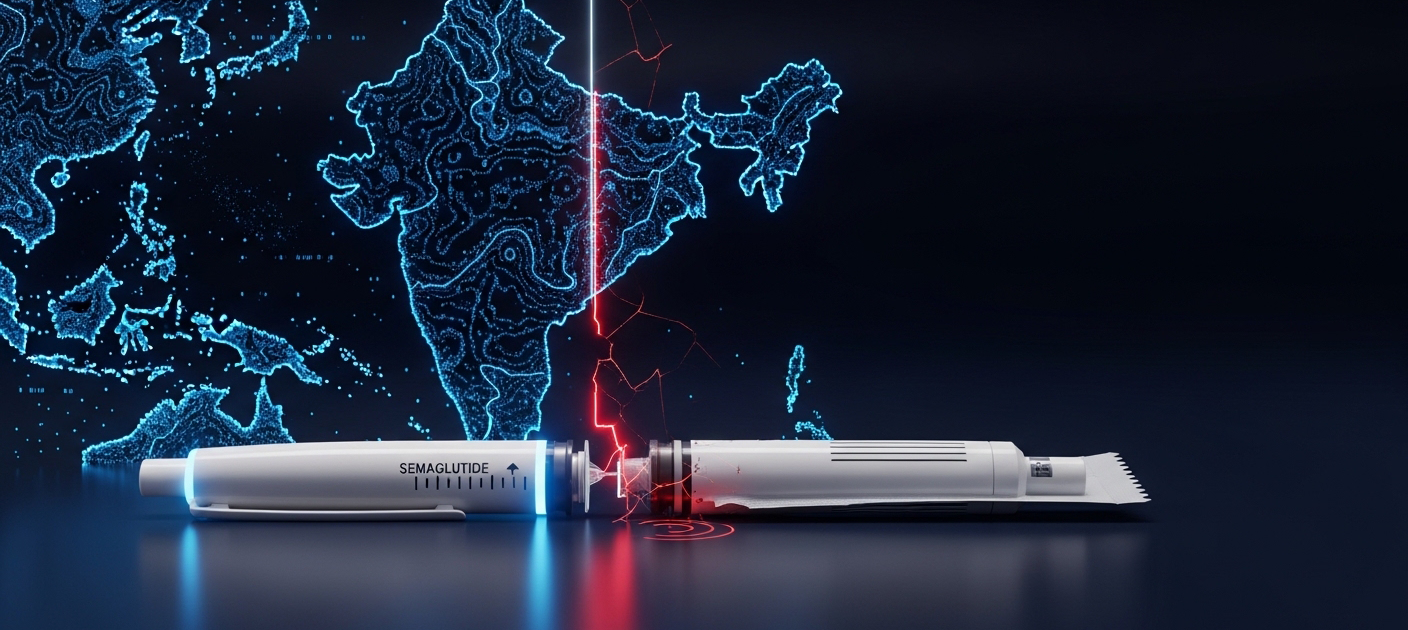
On March 20, 2026, Novo Nordisk's patent on semaglutide — the active ingredient behind Ozempic and Wegovy — expired in India. Within hours, generic versions from Natco Pharma and Eris Lifesciences were on the market. Over 40 additional manufacturers are right behind them.
For the 100 million diabetics and 250 million obese individuals across India, this is transformative. Monthly treatment costs are dropping from ₹8,800–₹16,400 to as low as ₹1,290. The promise: life-changing medication, finally accessible.
The problem: India's pharmaceutical market is one of the most counterfeit-infiltrated on Earth. And the world's most counterfeited drug class just got a whole lot easier to fake.
The timing is striking. Just days before the patent expired, two reports landed that should alarm every pharmaceutical manufacturer preparing to enter the generic GLP-1 space.
First, The Lancet published a March 2026 report titled The boom in counterfeit obesity drugs, documenting how falsified versions of GLP-1 medications have been detected in nearly 60 countries. The WHO's Global Surveillance and Monitoring System has tracked rising reports of falsified semaglutide products across all geographic regions since 2022. The report's conclusion: the combination of extraordinary demand, high prices, and limited supply has created what the Partnership for Safe Medicines calls unprecedented levels of pharmaceutical fraud.
Second, the ASPA–CRISIL State of Counterfeiting in India 2025 report — released March 17, 2026 — found that counterfeit medicines now account for an estimated 28% of India's pharmaceutical market. Nearly 89% of urban Indian consumers have purchased a counterfeit product at least once, and 74% believe counterfeiting has worsened in the past twelve months.
Now overlay these two realities: the world's fastest-growing counterfeit drug category is about to flood a market where more than one in four medicines may already be fake.
Semaglutide counterfeiting isn't hypothetical. It's already a documented, escalating crisis — and that was before generics entered the picture.
The FDA has seized counterfeit Ozempic from the legitimate U.S. supply chain three separate times: December 2023, April 2025, and December 2025. In the most recent seizure, counterfeit pens carried authentic lot numbers but could be identified only by the misplacement of expiration text on the label — a detail most patients would never notice.
The WHO issued a formal Medical Product Alert on falsified Ozempic in June 2024 after confirmed seizures in Brazil, the United Kingdom, and the United States. Some falsified pens contained relabeled insulin — a substitution that can cause life-threatening complications for patients expecting semaglutide's distinct mechanism of action.
Counterfeit GLP-1 products have caused documented cases of hyperglycemia, cardiovascular complications, and treatment failure across multiple countries. The needles in seized counterfeit pens could not be confirmed as sterile, adding infection risk on top of the unknown drug contents.
These incidents occurred in regulated markets with serialization mandates and established supply chain oversight. India's generic explosion is entering a market where enforcement infrastructure faces far greater structural challenges.
Related: Mexico's Counterfeit Pill Crisis: How ForgeStop's Tap-to-Verify Stops Deadly Fakes — Over 68% of pharmacies in northern Mexico were found selling counterfeit or unregulated pharmaceuticals. Learn how NFC-enabled smart packaging is protecting patients at the point of care.
Not all generics carry the same counterfeit risk. GLP-1 receptor agonists — particularly injectable semaglutide — sit at the intersection of every factor that drives pharmaceutical counterfeiting:
Massive, urgent demand. India has the world's third-largest overweight population and approximately 90 million adults with diabetes. Only 200,000 are currently on GLP-1 therapy. The addressable market is enormous, and patients are motivated.
Price sensitivity creates gray market incentives. Even with generics priced 80–90% below the innovator product, demand will outstrip supply during the initial rollout. That gap — the window between what patients want and what authorized channels can deliver — is precisely where counterfeiters operate.
Cold-chain complexity. Injectable semaglutide requires refrigerated storage and handling. In a country where cold-chain infrastructure varies dramatically between urban centers and smaller cities, maintaining product integrity from manufacturer to patient is a significant operational challenge. Temperature excursions are difficult for patients to detect, and counterfeiters exploit this opacity.
Injectable format raises the stakes. Unlike tablets, injectable counterfeits carry additional risks: unsterile needles, unknown injectable substances, and incorrect concentrations that can cause immediate adverse events. The margin for error is effectively zero.
Fragmented distribution. With 40+ manufacturers launching simultaneously across India's vast distribution network — where local retail outlets account for 63% of pharmaceutical purchases — tracking and authenticating every unit becomes exponentially more difficult.
Related: From Reactive to Proactive: Combating Counterfeit Pharmaceuticals with Smart Label Technology — Discover how NFC-enabled smart labels are shifting pharmaceutical security from post-market alerts to real-time, tap-to-verify authentication at every point in the supply chain.
Here's the uncomfortable truth: India's generic GLP-1 manufacturers will compete primarily on price. The first wave already proves this — Natco's vial format launches at ₹1,290/month, roughly 90% below the innovator. In a race to the bottom on cost, the risk is that authentication and traceability become afterthoughts rather than differentiators.
But the manufacturers who will build lasting market share aren't the ones offering the lowest price point. They're the ones whose patients — and prescribers — trust every unit that reaches a clinic, pharmacy, or home.
NFC-based smart labels offer a fundamentally different approach to this challenge. Unlike QR codes (which can be photographed and cloned within minutes) or holograms (which are routinely replicated by sophisticated counterfeit operations), NFC authentication is cryptographically secured at the chip level. Each tag generates a unique, encrypted response that cannot be duplicated.
For generic semaglutide manufacturers, this means:
Tap-to-verify authentication. Patients and pharmacists confirm product authenticity with a smartphone tap — no app download required. In a market where patient trust is the primary barrier to GLP-1 adoption, instant verification becomes a competitive advantage, not just a safety feature.
Cold-chain and tamper evidence. NFC-enabled smart labels can be embedded in tamper-evident seals. If a package is opened, resealed, or compromised at any point in the supply chain, the tag becomes unreadable — invalidating the product before it reaches the patient.
Real-time supply chain intelligence. Every scan generates time-stamped, geolocated data. Manufacturers gain visibility into where their products are being verified — and, critically, where they're not. Anomalous scan patterns can flag potential diversion or counterfeit infiltration before it becomes a patient safety event.
Regulatory readiness. The EU's Digital Product Passport (DPP) regulation, effective 2027, will require product-level digital identity for pharmaceutical products entering European markets. Indian generic manufacturers with global ambitions can build DPP-ready infrastructure now, using the same NFC platform that protects domestic distribution.
Related: QR Code vs. NFC for Brand Protection: What's Best in 2025? — QR codes are easily cloned. NFC is cryptographically unique. This side-by-side comparison explains why leading pharma brands are making the switch to NFC-based authentication.
The GLP-1 generic wave in India is not a future event — it began yesterday. The counterfeit infrastructure targeting these drugs is not theoretical — it's been documented by the FDA, WHO, and The Lancet in the past 90 days alone.
For generic manufacturers, the strategic calculation is straightforward: authentication costs a fraction of a recalled batch, a regulatory action, or a patient safety incident that destroys brand credibility in a market you just entered.
For the 100 million patients who stand to benefit from affordable GLP-1 therapy, the stakes are even simpler. The medicine in their hands should be the medicine on the label.
The technology to guarantee that exists today. The question is which manufacturers will deploy it before the counterfeits arrive — not after.
Ready to protect your generic pharmaceutical launch with tap-to-verify NFC authentication? Talk to ForgeStop →
Sources: WHO Medical Product Alert N°2/2024; FDA Drug Safety Communications (Dec 2023, Apr 2025, Dec 2025); The Lancet, "The boom in counterfeit obesity drugs" (Mar 2026); ASPA–CRISIL "State of Counterfeiting in India 2025" (Mar 2026); Bloomberg; BusinessToday India; C&EN.

March 4, 2026
NFC authentication secures the product. Dual-frequency RFID smart labels secure the entire supply chain — from batch production to warehouse to patient.

April 2, 2026
NFC powers the tap-to-pay tech you use daily—but it's also a game-changer for brand protection. Learn how NFC works, why it’s more secure than QR codes, and how brands use it to authenticate products, fight counterfeits, and engage consumers with trust.

April 2, 2026
India’s QR code-based drug authentication is failing—leaving consumers at risk. Learn why counterfeiters are exploiting static codes and how NFC smart labels like ForgeStop InfoTAP offer a tamper-proof alternative for pharmaceutical safety.

.svg)
.svg)

.svg)
.svg)

