
June 3, 2026
RAIN solves the warehouse. NFC solves the patient. One dual-frequency chip now does both on every pharma pack. 2026 is when it converges.
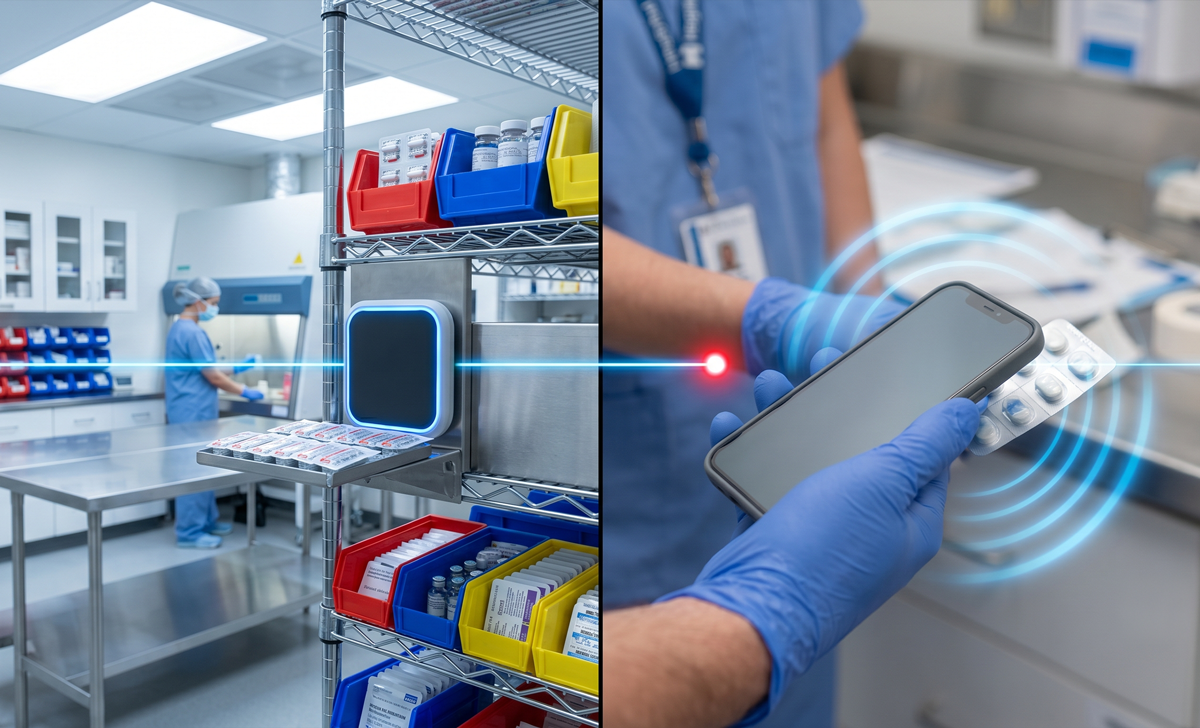
Pharma packaging is converging on a single piece of silicon, and most procurement teams haven't caught up to it yet.
The technology isn't new. UHF RFID has worked at warehouse scale for two decades; NFC has been in every smartphone for ten plus years. What changed in recent years is that one chip now does both, on the same square inch of label, with one shared identity and shared memory, with security, traceability and accessibility.
That's the inflection. And it's about to reshape what gets bought into pharmaceutical packaging in 2026.
RAIN RFID, the UHF flavor most healthcare deployments are built on, operating at 860 to 960 megahertz, is read by infrastructure: gates, shelves, handheld scanners at receiving docks and on hospital floors. A patient holds the same pack and doesn't have infrastructure. A patient has a phone. NFC, at 13.56 megahertz, is built into every smartphone in the world.
The new era is what happens when both NFC and UHF live on the same chip, on the same pack, carrying the same identity.
Item-level tagging in pharma used to be a procurement conversation that ended fast: at case-and-pallet scale, the math worked; at unit scale, it didn't. That ratio shifted. Inlay costs fell, label converters built RFID into their lamination lines without retooling, and chip designers stopped treating UHF and NFC as separate products.
The result is a category of silicon that does both: UHF for the warehouse, NFC for the patient, on a single chip with one shared memory and one identity. EM Microelectronic's EM4425 is the chip ForgeStop builds on for that class of use case. A UHF reader picks up an entire shelf of packs at distance; a phone tap on any one of those packs returns the same GTIN, the same serial, the same authentication state.
That's the architectural change worth paying attention to. Not a new technology. A different relationship between two existing ones.
The case for RAIN RFID at item level in healthcare is well-rehearsed and accurate. Real-time inventory accuracy at the dock and on the shelf. Reduced manual scanning labor. Tighter expiration management, knowing not just what's in stock but which lots are aging out. Faster recall response when a serial range needs to be quarantined. Better product availability in pharmacies and hospital floors where a stockout has clinical consequences.
These payoffs are operational, measurable, and increasingly required. Our earlier analysis of NFC and RFID in the pharma supply chain walks through the supply-chain visibility layer in more depth. That piece focuses on how smart-label data turns each pack into a real-time signal across distribution, with every scan, every read, every event captured against a single product identity.
What the supply-chain framing tends to leave out is what happens to the same pack after it leaves the warehouse.
A patient gets the pack at the pharmacy. The pack still has the same chip. The chip still carries the same GTIN. But the warehouse readers and gates are now miles away.
NFC closes that gap. Every modern smartphone (iPhone and Android, no app required) can read an NFC tag from one centimeter away with a single tap. That tap can do four things at once on a regulated package: authenticate the pack cryptographically, deliver the EMA-approved electronic leaflet (ePI) in the patient's language, surface the brand's non-statutory content, and emit a real-time event back to the brand's supply-chain dashboard.
If you've read our piece on the connected-product layer, this is the architecture in action. That post explains how a single chip-enabled package delivers four payloads (statutory ePI, brand content, anti-counterfeit verification, and supply-chain telemetry) through one tap, replacing what most pharma brands today buy from four different vendors.
The reason dual-frequency silicon matters isn't novelty. It's that the same physical tag now serves both audiences (operations and patient) without forcing the brand to choose, or to encode and apply two tags on the same pack.
What the warehouse side gets: real-time inventory accuracy, reduced manual labor, tighter expiration management, faster recall response, better product availability across pharmacies and hospital floors.
What the patient side gets: cryptographic proof the pack is real, the EMA-approved electronic leaflet on a phone tap, brand-owned content (patient onboarding, adherence, multilingual support), and a real-time event back to the brand the moment the pack is in the patient's hand.
What the brand gets: one source of truth across both audiences. One chip purchase. One encoding step. One supply-chain telemetry stream, from production line to patient hand. Track-and-trace, supply-chain visibility, cryptographic authentication, and patient information delivery (four jobs the brand used to buy from four different vendors) now run on the same chip.
None of this works without an addressing standard, and that's the GS1 layer.
GS1 Digital Link turns a GTIN into a resolvable web address, one URL that can serve a checkout scanner, a warehouse reader, and a consumer's phone, depending on who's asking. Product master data (GTIN, lot, expiry, country of origin) gets registered through GS1's GDSN and travels with the pack in both printed (GS1 DataMatrix, as the EU Falsified Medicines Directive has required since 2019) and encoded (chip memory) form.
On a dual-frequency chip, the GS1 identity is written directly into chip memory at production. UHF readers and NFC readers see the same GTIN from the same silicon. That sounds like a small technical detail. In practice it removes an entire class of database-lookup logic and is the reason the chip-level approach holds up under regulated audit.
For a deeper look at why the printed code alone is not enough, and why a cryptographically anchored chip is structurally different from a QR, our piece on QR codes versus NFC for brand protection walks through the trust-model difference. A printed code can be cloned by anyone with a desktop printer; a cryptographic chip cannot be cloned without per-tag key extraction.
The standard is GS1's. The chip is EM Microelectronic's. The platform that encodes the standard onto the chip at production, resolves the tap in real time, and delivers the four payloads to the right audience (patient, pharmacist, or warehouse) is ForgeStop. Standard, silicon, platform. None of the three works alone.
The European Medicines Agency's March 2026 ePI implementation roadmap puts vaccines on a Q3 2026 voluntary go-live and oncology medicines on Q4 2026. Mandatory ePI follows for all newly authorised medicines once the revised EU pharmaceutical legislation enters into application.
That deadline pressure has a counter-intuitive effect: brands that already need to deliver ePI through a digital trigger on the pack (a QR code or a smart chip) discover that adding the warehouse-RFID payload to the same chip is a marginal incremental investment, not a parallel program.
A pack that needs a chip for one regulated reason inherits all the others. That's the architectural inflection. Not RFID becoming new. RFID becoming inevitable on the same surface that ePI, authentication, and brand engagement already require.
ForgeStop will be on the show floor at GS1 Connect 2026 in Las Vegas, June 9 to 11, in partnership with Maxim Label and Packaging, the print-and-laminate layer that the smart chip slots into without changing a packaging line.
Find us at booth #601, in the AI Portrait Parlor Activation Area.
We'll have live working demos: a single pack that authenticates with a phone tap, reads at warehouse range, and delivers ePI, brand content, and supply-chain telemetry from the same chip. If you're working through item-level RFID, ePI go-live for Q4 2026, or both at once, the booth is the right place to have that conversation.
Come find us at booth #601. Or, if you're not in Las Vegas, drop us a note and we'll walk you through the same demo remotely.

June 4, 2026
EMA's March 2026 ePI roadmap sets a Q4 go-live for vaccines and oncology. Here's the compliance checklist pharma manufacturers need to act on now.
June 4, 2026
The DataMatrix on every prescription pack already carries product data. By 2027, the same square inch will deliver four digital payloads in one tap.

March 4, 2026
NFC authentication secures the product. Dual-frequency RFID smart labels secure the entire supply chain — from batch production to warehouse to patient.

.svg)
.svg)

.svg)
.svg)