July 30, 2026
NFC smart labels are the enabler, not the product. How connected products turn every unit into a first-party channel for engagement, loyalty and control.

Something has shifted in how brands ask about smart packaging.
Two years ago the opening question was how to stop counterfeits. Now the marketing team arrives with a mandate from its own board: evaluate connected packaging for engagement, for retail media, for EU digital labeling readiness.
Authentication is still in the brief. It has just moved down the page.
That reordering is the most useful thing to happen to this category in a decade. Not because authentication stopped mattering, but because it was never the product.
It was the enabler. Proving an item is real is what makes the person holding it knowable, and knowing that person is what turns the product into a channel.
Skip a step and the one after it does not work.
A printed label is finished the moment it goes to press. Same words for everyone, one language, one market, for the life of the run.
And it never says anything back.
An authenticated tap is a different kind of object. The experience behind it cannot be reached any other way.
There is no address to copy, no link to forward, no screenshot that gets somebody in. Each tap produces dynamic, single-use cryptographic proof rather than a fixed destination.
So if a person is looking at that screen, they are holding your product. Not a photo of it, not a marketplace listing, not a convincing fake.
That is an unusual thing for a marketer to own. Every other channel is addressed to someone who might buy, might have bought, or might be a bot.
This one is addressed to someone with the item in their hands.
The seal is part of the same proof. A tamper-evident smart label knows whether it has been opened, which matters for security in the obvious way and for two things that have nothing to do with security at all.
👉 Related reading: How NFC works for product authentication: a plain-language walkthrough of what happens between a phone touching a label and a verified result appearing, and why that exchange cannot be copied, forwarded, or replayed.
If you sell through big-box retail and marketplaces, most of the people who love your product are invisible to you. The retailer knows them. The marketplace knows them.
You know a shipment number and a sell-through report six weeks late.
A tap at unboxing closes that gap at the moment the buyer is most willing to engage. The box is open, the product is new, curiosity is at its peak.
Registration takes seconds and returns something real: warranty, support, proof of ownership tied to that exact item.
This is not a loyalty program. It is first-party data recovery, and framing it that way changes which budget line it comes from.
It also settles an old argument. Marketplaces have been treated as a margin threat for fifteen years.
Under this model they become the top of the funnel. Let the marketplace acquire the customer and keep its cut on the first purchase.
The tap pulls the second, third and fourth purchase direct, where the margin and the relationship both live.
Now back to that broken seal. Conversion tells you a unit sold; an opened seal tells you a unit was used.
Proof of purchase and proof of first use, on the same event, with no form to fill in.
That signal travels well beyond marketing. Warranty claims arrive with an answer to the question everyone argues about, which is whether the item was ever opened.
Replenishment forecasting gets a real consumption signal instead of a sell-in guess. Support tickets arrive already knowing which unit, which batch, which retailer, and whether the seal was broken.
None of it requires collecting anything sensitive. Forms, loyalty records and customer data stay on the brand's own domain and servers.
The connected layer sees authentication events, not personal information. Location sharing is consumer opt-in: precise with consent, approximate without, useful either way.
👉 Related reading: Bridging the trust gap with NFC smart labels: how packaging becomes a two-way channel rather than a one-way statement, and what marketers get back from a tap beyond a verified result.
👉 Related reading: How NFC and RFID make supply chains smarter and safer: what changes operationally when visibility continues past the distribution centre instead of going dark the moment product ships.
Nothing about the experience is fixed at the factory.
Each unit picks up context as it moves. It can know which chain it shipped to, which region it landed in, which language the person tapping it reads.
The ten thousand units that went to one retailer can run a campaign the other forty thousand never see. Different offer, different hero video, different next step.
Change it on Tuesday morning and it is live on Tuesday morning, on stock already sitting on shelves three thousand miles away.
Existing labels convert without a packaging redesign. It lands on your next launch, not your next rebuild.
Individual identity is what makes any of it possible. A batch code identifies a production run: fifty thousand units made on a Thursday.
It cannot tell you which unit, where it went, or whether it ever reached a customer.
That difference opens mechanics with no equivalent in print. Because every item is individually addressable, one unit in a hundred thousand can carry something no other unit carries.
A seeding drop where a single box opens onto an experience nobody else receives. A limited run where one in fifty is a different tier.
Marketers have faked this with codes and sweepstakes for years. Here it is simply a property of the item.
The broken seal returns one last time, now as a switch. Sealed is the shelf: the moment of choosing, a scent quiz, a fit guide, the gifting reveal for a second person who never bought anything.
Opened is ownership: registration, rewards, replenishment, content only owners see. Same label, same unit, two entirely different jobs.
👉 Related reading: Why cosmetics brands are moving to smart label authentication: a category where packaging carries enormous brand weight and counterfeits travel fast, and where per-unit identity solves a marketing problem and a safety one at the same time.
Commission Regulation (EU) 2023/1545 added 56 fragrance substances to the list requiring individual declaration on cosmetic labels. Non-compliant products may be placed on the EU market only until 31 July 2026, with sell-through to 31 July 2028.1
That is a real constraint on a pack already carrying multilingual ingredients, claims and regulatory marks.
The temptation is to treat a digital layer as the release valve. It is not, and getting this wrong is a compliance problem rather than a marketing one.
Wine is the precedent. Since December 2023, ingredients and the nutrition declaration may be provided electronically, but the Commission was explicit that allergens and the energy value stay on the physical label.2
Digital supplements disclosure. It does not substitute for it.
What digital carries well is everything physical cannot: complete information in every language of every market, corrected the day it changes rather than the next print run.
Meanwhile the infrastructure has arrived. The European Commission brought the Digital Product Passport Registry live on 20 July 2026, with the first implementation deadline set for 18 February 2027.3
Six of the eight harmonised standards are already published, covering unique identifiers, interoperability, data carriers, APIs, data exchange and storage.
A unique identifier on the item, resolved through a data carrier, is becoming standard infrastructure rather than a brand experiment.
Every brand that adds a connected layer for marketing reasons in 2026 arrives at that deadline already holding the hard part.
👉 Related reading: The Digital Product Passport, explained: what the DPP actually requires, which categories are affected first, and why the identifier layer matters more than the compliance paperwork.
Worth being honest here, because most vendor material is not.
Nobody taps a bottle of shampoo to check it is genuine. Authentication matters enormously in pharmaceuticals and spirits, where global trade in counterfeit goods was valued at approximately $467 billion in 2021.4
But it is rarely why a consumer reaches for their phone.
Tap motivation is a design outcome, not a property of the technology.
People tap because the unboxing invites it. Because a gift arrives with something to open. Because there is a reward, or a collection to complete, or the product does something useful when asked.
Curiosity earns the first tap. Usefulness earns every one after that.
So the honest brief is not "what does the label do." It is "what is worth doing here, for this person, at this moment, that they cannot get anywhere else."
Protect proves it is real. Connect makes the buyer knowable. Experience is still your job.
Talk to ForgeStop about mapping a connected layer onto your existing packaging line → forgestop.com/contact
July 28, 2025
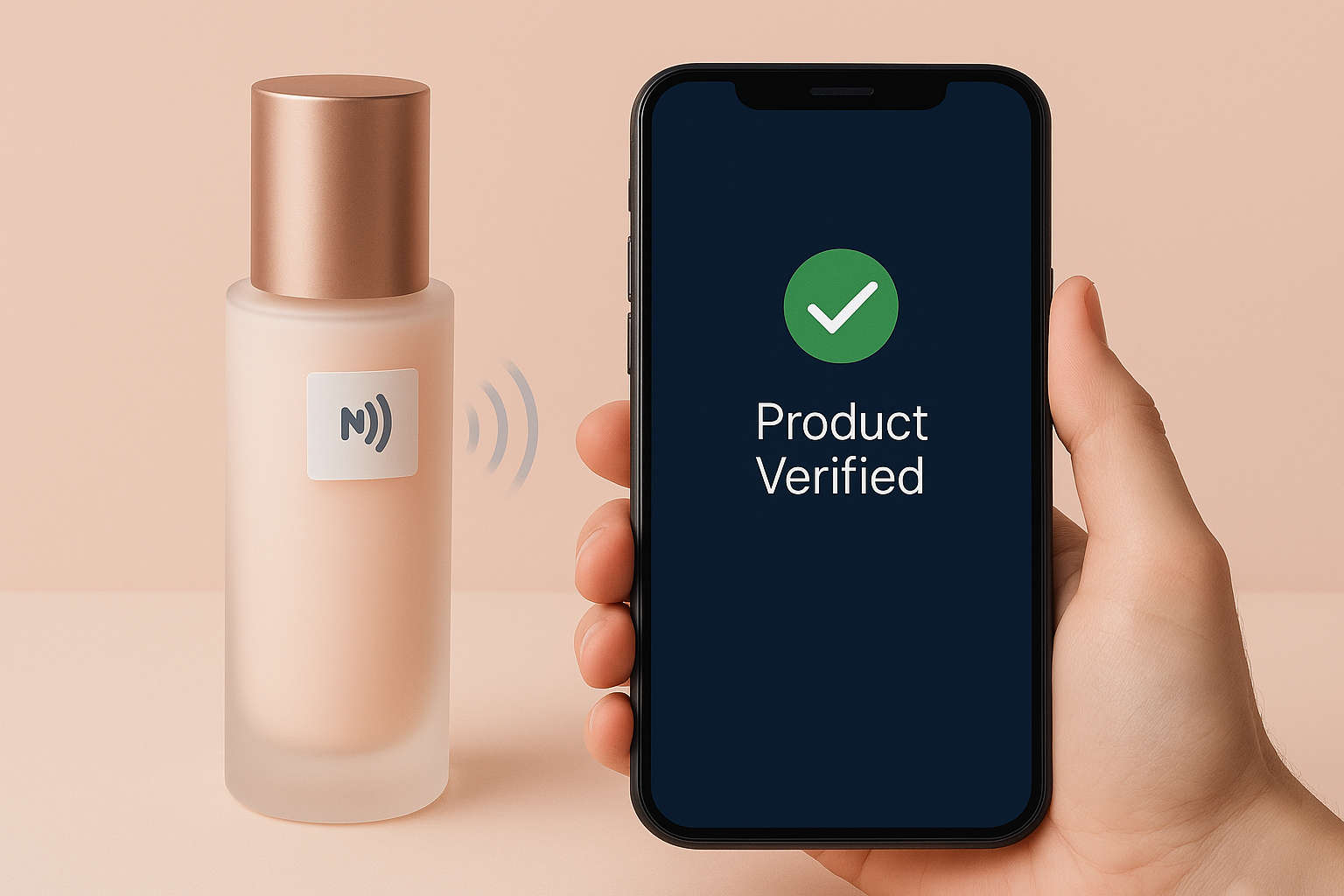
Over 67% of beauty products on online marketplaces are likely fake—posing serious health risks to millions. From toxic ingredients to skin damage, counterfeit cosmetics are on the rise. Learn how NFC smart label technology from ForgeStop offers real-time protection with tap-to-verify authentication—no app needed.

June 19, 2025
ForgeStop’s NFC smart labels go beyond authentication to enable powerful consumer engagement, digital marketing, and brand loyalty—right at the product level.

April 2, 2026
NFC powers the tap-to-pay tech you use daily—but it's also a game-changer for brand protection. Learn how NFC works, why it’s more secure than QR codes, and how brands use it to authenticate products, fight counterfeits, and engage consumers with trust.

.svg)
.svg)

.svg)
.svg)

